TL;DR:
- Rental fleet depreciation is highly volatile and impacts profitability significantly.
- Effective management involves real-time tracking, strategic buying, maintenance, and disposal timing.
- Using software like Nomora helps optimize depreciation analysis, asset decisions, and financial reporting.
Rental fleet depreciation is one of those costs that looks predictable on paper but behaves like anything but in practice. Most fleet managers treat it as a fixed line item, something to calculate once a year and move on. That assumption is expensive. Used car markets swing hard, residual values collapse without warning, and the method you use to count depreciation changes your tax bill, your reported profits, and your replacement timing all at once. This guide breaks down what rental fleet depreciation actually is, why it's so volatile, and how to manage it in a way that protects your margins and sharpens your asset decisions.
Table of Contents
Key Takeaways
| Point | Details |
|---|
| Depreciation volatility | Rental fleet depreciation costs swing dramatically with used car market changes, directly impacting profits. |
| Tax vs. book methods | Choosing between tax and book depreciation alters reported profits and cash flow, so it pays to plan carefully. |
| Actionable management | Smart acquisition, optimized holding, and software-driven cycling strategies can significantly reduce depreciation loss. |
| Continuous monitoring | Monitoring market trends and updating your strategy is essential to navigate unpredictable fleet costs. |
What is rental fleet depreciation?
At its core, depreciation is the loss in value a vehicle experiences from the moment you acquire it to the moment you sell or retire it. For rental fleets, that loss isn't just an accounting entry. It's the single largest operating expense after the initial vehicle purchase, and it directly shapes how profitable each unit in your fleet actually is.
Several factors drive how fast a vehicle depreciates:
- Purchase price: Higher acquisition costs mean more value at risk from day one.
- Age and mileage: Rental vehicles accumulate miles fast. High mileage accelerates value loss.
- Condition: Damage, wear, and deferred maintenance all reduce resale value.
- Market demand: If buyers aren't interested in a particular model, its residual value drops regardless of its condition.
- Fuel type and technology: EVs and hybrids face unique depreciation curves as technology evolves.
The basic formula is straightforward: subtract the expected resale value from the purchase price, then divide by the number of years you plan to hold the vehicle. For example, a vehicle purchased at $35,000 with an expected resale of $15,000 after four years depreciates at roughly $5,000 per year. Simple enough, until the resale market moves.
As financial performance data shows, depreciation drives profit and loss swings in rental fleets, shaping overall financial performance especially when residual values shift rapidly. That's the part most managers underestimate. When the used car market softens, your annual depreciation cost rises even if you haven't changed a thing about how you operate. Understanding fleet management essentials is the foundation for getting this right.
Pro Tip: Track depreciation monthly, not just annually. In volatile markets, a quarterly review is the minimum. Monthly tracking lets you catch residual value erosion early and adjust your replacement timing before the losses compound.
Methods of calculating depreciation: Tax vs. book
How you calculate depreciation matters as much as what you're depreciating. There are two primary frameworks rental businesses use, and they serve very different purposes.
1. Tax depreciation (MACRS)
The IRS's Modified Accelerated Cost Recovery System allows businesses to front-load deductions. Vehicles depreciate faster on paper in the early years, giving you larger tax deductions upfront. For rental fleets, this can meaningfully reduce taxable income in the first two to three years of ownership.
2. Straight-line depreciation (Book/GAAP)
This method spreads the cost evenly across the vehicle's expected useful life. It's the standard for financial reporting under Generally Accepted Accounting Principles (GAAP). It produces smoother income statements but doesn't optimize tax timing.
3. Units of production
Less common but worth knowing: depreciation is tied directly to mileage. The more a vehicle is driven, the more it depreciates. This can be useful for fleets with highly variable utilization.
4. Declining balance
A middle ground between MACRS and straight-line, this method applies a fixed percentage to the remaining book value each year, front-loading costs without the full acceleration of MACRS.
Here's a side-by-side comparison to clarify the key differences:
| Method | Purpose | Depreciation pace | Best for |
|---|
| MACRS | Tax reporting | Accelerated (front-loaded) | Reducing early tax liability |
| Straight-line | Financial reporting | Even, year by year | Stable income statements |
| Units of production | Operational tracking | Usage-based | High-mileage fleet analysis |
| Declining balance | Hybrid reporting | Moderate front-loading | Mid-size fleet planning |
As auto rental cost data confirms, contrasting MACRS for tax purposes with straight-line for financial reporting creates profit swings that can mislead operators who only look at one set of numbers. Your fleet reporting insights should always show both views side by side.
Pro Tip: Align your depreciation method with your fleet replacement strategy. If you cycle vehicles every two to three years, MACRS gives you the most tax benefit. If you hold vehicles longer, straight-line may produce more accurate profitability reporting.
The impact of the used car market on depreciation
Even the most carefully chosen depreciation method can't protect you from what the used car market decides your vehicles are worth. This is where rental fleet economics get genuinely unpredictable.

Residual value, the amount you can realistically expect to recover when you sell a vehicle, is the single biggest variable in your depreciation equation. When residual values are high, your annual depreciation cost drops. When they fall, your cost per vehicle rises, sometimes dramatically.
The 2021 to 2025 period is a case study in this volatility. According to auto rental cost research, used car value retention for rental fleets peaked at 82% in 2021, then dropped to 53% by 2025. That's a 29-percentage-point swing in residual value over four years.
Here's what that looks like in real numbers for a $35,000 vehicle:
| Year | Residual value % | Estimated resale value | Annual depreciation (4-yr hold) |
|---|
| 2021 | 82% | $28,700 | $1,575 |
| 2023 | 68% | $23,800 | $2,800 |
| 2025 | 53% | $18,550 | $4,113 |
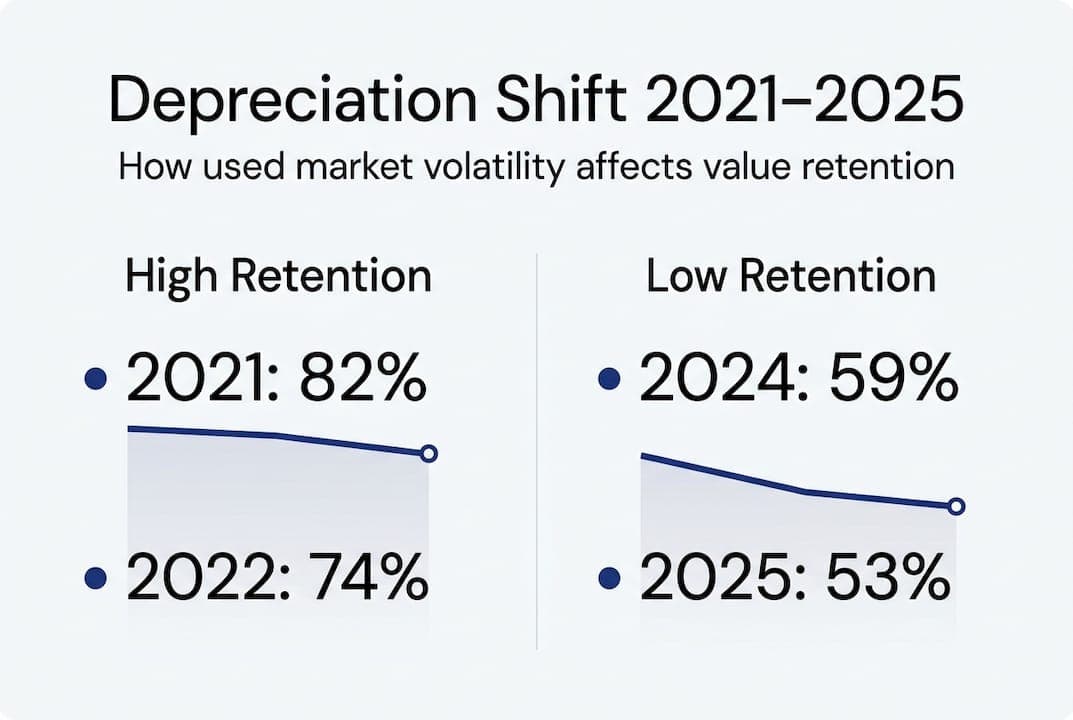
That's a difference of roughly $2,500 per vehicle per year between the peak and trough. Multiply that across a fleet of 50 vehicles and you're looking at $125,000 in additional annual depreciation cost, with no change to your operations.
The practical implications are significant:
- Higher residuals mean you can hold vehicles longer without increasing per-unit costs.
- Lower residuals make early cycling more attractive, even if it feels counterintuitive.
- Rapid market shifts demand that your pricing strategies account for changing asset costs in real time.
- Monitoring market trends regularly gives you earlier signals to adjust your fleet mix.
Building flexibility into your asset management budget isn't optional. It's a basic requirement for operating in a market where residual values can move 30 points in either direction.
Strategies to manage and minimize rental fleet depreciation
Knowing where depreciation risk comes from is only half the job. The other half is taking deliberate action to reduce it. Here are the five most effective strategies:
-
Buy right from the start. Acquisition price is the ceiling on your depreciation exposure. Vehicles with strong brand reputations, proven resale demand, and lower starting prices give you a structural advantage before the first rental.
-
Cycle vehicles strategically. As fleet cycling research shows, the decision to hold longer versus cycle fast depends entirely on where the used car market is. In a strong resale market, selling earlier locks in favorable residuals. In a soft market, holding can preserve value if maintenance costs stay low.
-
Maintain vehicles consistently. Documented service history, clean interiors, and low cosmetic damage all support higher resale prices. A vehicle that looks well-cared-for sells for more, period.
-
Time your disposals. Seasonal demand for used vehicles is real. Convertibles and SUVs sell better at certain times of year. Aligning your disposal schedule with peak buyer demand can add hundreds to thousands of dollars per unit.
-
Diversify your fleet mix. Concentrating in one vehicle type or brand creates residual value risk. A diversified fleet spreads that risk across different market segments. Review your inventory management approach to ensure your mix reflects current demand, not last year's assumptions.
"Residual volatility creates swings of up to 30 percentage points from peak to trough, making timing the single most powerful lever in fleet depreciation management."
Pro Tip: Use fleet management software to set automated alerts when a vehicle's projected resale value drops below your target threshold. This removes the guesswork from replacement timing and lets you act before the loss compounds. See how real fleet operators have applied this approach to measurable effect.
Why most rental fleets lose profits to overlooked depreciation traps
Here's the uncomfortable reality: most rental fleet operators manage depreciation reactively. They calculate it after the fact, report it annually, and adjust only when the pain is obvious. That's the wrong sequence.
The operators who consistently outperform their peers treat depreciation as a forward-looking lever, not a backward-looking write-off. They monitor residual value trends monthly, connect that data to their replacement schedules, and adjust pricing to reflect true asset costs in real time. That feedback loop between market conditions, operational data, and financial policy is what separates profitable fleets from struggling ones.
The conventional wisdom says you can't control depreciation. That's partially true. You can't control what the used car market does. But you can control when you buy, what you buy, how you maintain it, and when you sell. Those four decisions, made with current data rather than last year's assumptions, account for the majority of depreciation variance in a well-run fleet.
Investing in profit-boosting software strategies is how forward-thinking operators close the gap between what depreciation costs them and what it should cost them. The technology exists. The question is whether your current systems give you the visibility to use it.
How Nomora helps streamline fleet depreciation management
Managing depreciation well requires real-time data, automated alerts, and reporting that connects asset costs to business outcomes. That's exactly what Nomora is built to deliver.
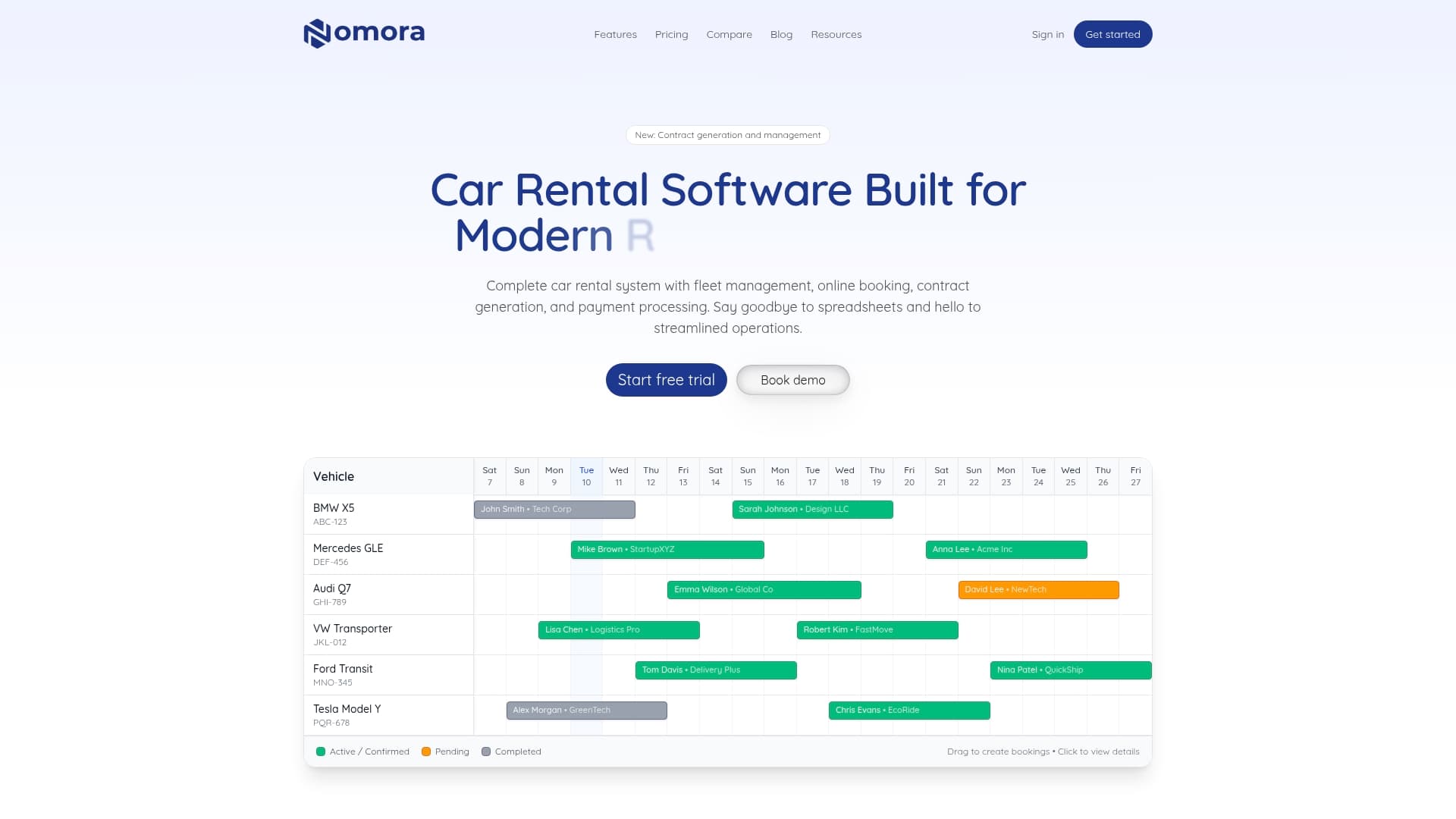
Nomora tracks per-vehicle costs, automates replacement timing recommendations, and links market-facing data to your internal profit reports. Its customizable depreciation reporting tools improve both budgeting accuracy and tax planning, giving you a clearer picture of true fleet profitability at any point in the year. Whether you manage 10 vehicles or 500, Nomora's fleet management platform scales with your operation. Explore Nomora use cases to see how rental businesses like yours are making smarter, faster asset decisions with less manual effort and fewer costly surprises.
Frequently asked questions
What is the difference between book and tax depreciation for rental cars?
Book depreciation uses straight-line methods to spread costs evenly for financial reporting, while tax depreciation uses MACRS to front-load deductions and reduce early-year tax liability.
Why did rental fleet depreciation spike after 2021?
Used-car market shifts caused residual values to drop from 82% in 2021 to 53% in 2025, meaning rental fleets recovered far less value per vehicle at disposal and absorbed higher annual depreciation costs.
How can rental businesses minimize the impact of depreciation?
The most effective approach combines smart acquisition, consistent maintenance, strategic disposal timing, and fleet software for replacement scheduling to capture the best available resale value.
Does leasing a fleet affect depreciation costs?
Leasing shifts some depreciation risk to the lessor, but under IRS rules like §280F, lessees may still be required to report certain depreciation-related amounts as income, affecting net tax outcomes.
Recommended