TL;DR:
- Effective fleet management is vital for maximizing vehicle availability, safety, and cost efficiency.
- Key technologies include telematics, predictive maintenance, cloud-based software, and dynamic pricing.
- Regular KPI tracking and centralized multi-location management improve profitability and operational performance.
Most rental business owners assume fleet management is simply about knowing where their vehicles are. That assumption costs money. True fleet management is the central nervous system of your entire operation, touching everything from how often your cars generate revenue to how much you spend keeping them road-ready. Fleet management is the set of processes, people, and systems used to manage a group of vehicles, ensuring they are available, safe, compliant, and cost-effective. This guide will define the concept, break down core methods, show you how to track ROI, address advanced challenges, and give you practical steps to apply it all.
Table of Contents
Key Takeaways
| Point | Details |
|---|
| Fleet management drives profits | Optimizing operations and vehicle use is the top lever for rental profitability. |
| Tech boosts utilization | Telematics, cloud software, and predictive maintenance can lift utilization by 10-20 percent. |
| Measure what matters | Tracking KPIs like utilization and cost per mile helps spot and fix early issues. |
| Solve advanced challenges | Centralized cloud platforms help tackle double bookings, EV charging, and multi-location mismatches. |
What fleet management means for car rentals
For most industries, vehicles are tools that support the business. For car rental companies, vehicles are the business. That distinction changes everything about how you manage them.
"Fleet management is the set of processes, people, and systems used to manage a group of vehicles or assets, ensuring they are available, safe, compliant, and cost-effective for business operations, particularly critical for car rentals where vehicles directly generate revenue."
In practice, fleet management covers four core activities: acquiring vehicles at the right cost, maintaining them to maximize uptime, redeploying or rebalancing them across demand points, and disposing of them before depreciation eats into margins. Each activity directly affects your bottom line.
For rental operators, the essential goals are straightforward:
- Maximize availability: Every day a car sits idle or in the shop is a day it earns nothing.
- Minimize total cost of ownership: Acquisition, fuel, maintenance, insurance, and disposal all add up.
- Ensure safety and compliance: Unroadworthy vehicles create liability and damage your reputation.
- Optimize utilization: The ratio of rented days to available days is your most direct profitability lever.
The fleet management guide for rental operators makes clear that technology and people must work together. Software handles data collection and automation. Your team handles judgment calls, customer relationships, and exception management. Neither works well without the other.
A useful way to think about it: fleet management is not a department. It is a discipline that runs through every part of your operation, from the moment a customer books online to the moment a vehicle is retired from service. Reviewing your inventory management best practices regularly is one of the fastest ways to identify where availability gaps and cost overruns are hiding. The Wikipedia overview of fleet management systems also provides helpful context on how these platforms have evolved.
Key fleet management methods and technologies
Knowing what fleet management covers is the starting point. Knowing how to execute it is where performance separates top operators from average ones.
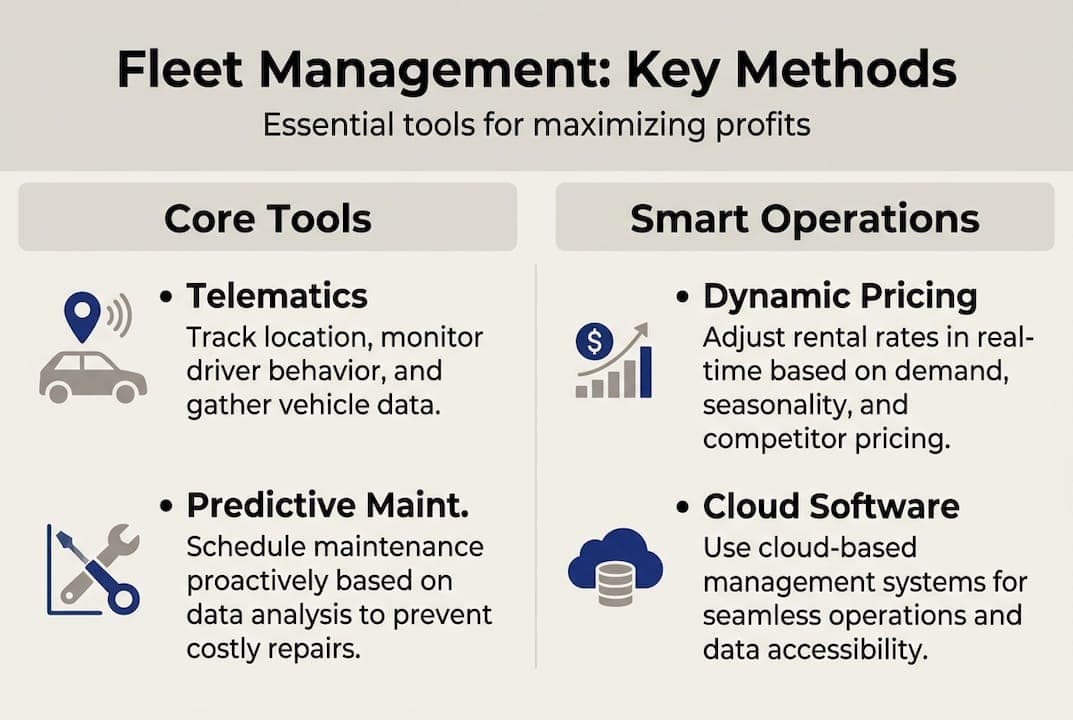
Core methodologies include telematics and GPS tracking, predictive maintenance, dynamic pricing, fleet rebalancing, utilization optimization, and cloud-based software integration. Each plays a specific role.
Telematics and GPS give you real-time location data, driver behavior insights, and mileage tracking. This is the foundation. Without it, you are managing by assumption.
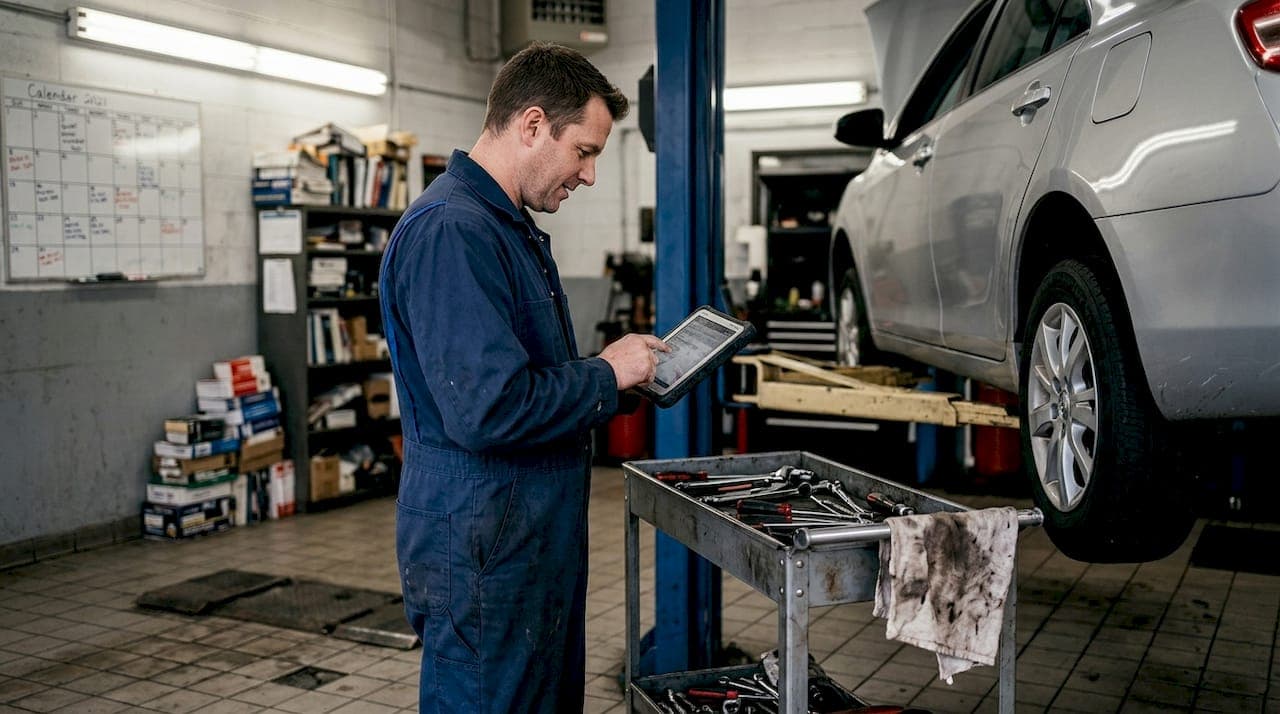
Predictive maintenance uses usage data and sensor alerts to schedule service before breakdowns happen. Predictive maintenance reduces breakdowns and costs by 18 to 22%, and Lean-TPM approaches increase vehicle availability by 10 to 20%. For a rental business, fewer unplanned breakdowns means fewer customer disruptions and lower emergency repair bills.
Dynamic pricing adjusts rental rates based on demand, seasonality, and competitor activity. It is one of the highest-leverage tools available to rental operators.
Cloud-based software ties everything together, giving you a single dashboard for reservations, maintenance schedules, contracts, and payments.
Here is a quick comparison of static versus dynamic fleet management approaches:
| Dimension | Static management | Dynamic management |
|---|
| Revenue potential | Fixed, predictable | Higher, demand-driven |
| Fleet utilization | Moderate (60-70%) | Strong (75-90%) |
| Operational complexity | Low | Moderate to high |
| Technology requirement | Minimal | Cloud software + telematics |
| Response to demand shifts | Slow | Real-time |
Top tools rental businesses should consider adding:
- Cloud fleet management platform for centralized reservations and reporting
- GPS telematics device for each vehicle
- Automated maintenance scheduler integrated with mileage data
- Dynamic pricing engine connected to your booking system
- Customer data platform for repeat booking insights
Pro Tip: If you are just starting out with technology, do not try to implement everything at once. Begin with telematics and basic AI forecasting, then layer in cloud fleet management tools once your team is comfortable with data-driven decisions. Complexity added too fast leads to low adoption and wasted investment.
Integrating platforms reduces manual errors significantly. When your booking system, maintenance tracker, and GPS data all feed into one place, you stop making decisions based on outdated spreadsheets.
KPIs and measuring fleet success
Technology and methods only matter if you can measure whether they are working. The rental operators who consistently outperform their competitors are not necessarily the ones with the biggest fleets. They are the ones who track the right numbers.
The four KPIs that matter most for car rental fleet management are:
- Utilization rate: The percentage of available vehicle days that are actually rented. Target range: 70 to 85%, with peaks reaching 90 to 95% during high-demand periods.
- RevPACD (Revenue Per Available Car Day): Total revenue divided by the total number of car days available. This tells you how efficiently your fleet generates income.
- Cost per mile (CPM): Total operating costs divided by miles driven. The 2026 benchmark CPM for trucks is approximately $2.26, a useful reference point.
- Maintenance cost as a percentage of revenue: Should sit between 5 and 15% for healthy rental operations.
| KPI | Healthy range | Warning sign |
|---|
| Utilization rate | 70-85% | Below 65% |
| Maintenance cost (% revenue) | 5-15% | Above 18% |
| RevPACD | Varies by market | Declining trend |
| Cost per mile | Below $2.50 | Rising quarter over quarter |
How to collect and assess these KPIs effectively:
- Pull utilization data weekly from your booking and fleet software.
- Track maintenance invoices against revenue in your accounting system monthly.
- Calculate RevPACD by dividing total monthly rental revenue by total available car days.
- Review CPM quarterly using odometer readings and total operating cost data.
- Compare each metric against your prior period and industry benchmarks to spot trends.
One statistic worth highlighting: dynamic pricing boosts revenue by 8 to 12% on average. That is a meaningful lift for any rental business operating on tight margins.
Pro Tip: Review your KPIs monthly, not just at year-end. Monthly reviews let you catch profit leaks early, before a slow utilization trend or rising maintenance costs become a serious problem. Check Geotab's KPI guide for additional benchmarks relevant to your fleet size.
You can also explore proven fleet optimization examples to see how other rental operators have used these KPIs to make smarter decisions.
Advanced challenges: Multi-location, electric vehicles, and edge cases
Once the fundamentals are in place, the next layer of complexity comes from scenarios that do not fit neatly into standard operating procedures. These are the situations that quietly drain profitability if you are not prepared.
One-way rentals are a common headache. A customer picks up in one city and drops off in another, leaving you with an imbalanced fleet. You now have too many cars in one location and not enough in another, often at the worst possible time.
Seasonal and geographic demand mismatches compound the problem. A beach location surges in summer while an airport location stays steady year-round. Managing inventory across these patterns manually is error-prone and slow.
Multi-location double bookings happen when reservation systems are not synchronized in real time. One car, two customers, one very bad day.
Electric vehicle (EV) integration introduces new variables. Charging infrastructure availability, range anxiety for customers, and longer turnaround times between rentals all affect utilization differently than traditional vehicles.
Common edge cases and practical fixes:
- Fleet imbalance from one-way trips: Use dynamic pricing to incentivize returns to underserved locations.
- Seasonal demand swings: Build a rolling 90-day demand forecast and adjust fleet size proactively.
- Double bookings: Implement real-time inventory sync across all locations through centralized software.
- EV charging gaps: Map charging infrastructure before deploying EVs at a location.
- Reactive maintenance cycles: Shift to predictive scheduling using mileage triggers and telematics alerts.
"Centralization can help SMEs gain 10 to 20% more utilization by eliminating the blind spots that come from managing each location independently."
The multi-location management strategies that work best share one common trait: a single source of truth for all fleet data. When every location feeds into the same platform, you can rebalance inventory, prevent conflicts, and respond to demand shifts in real time rather than after the fact. The fleet guide for advanced scenarios covers these topics in greater depth for operators ready to scale.
Our perspective: The overlooked levers that drive rental fleet profitability
Most rental operators, when they want to grow revenue, think about buying more cars. It is an understandable instinct. More vehicles means more rentals, right? Not necessarily.
What experience consistently shows is that the biggest gains come from using existing assets better, not from adding new ones. A fleet running at 65% utilization does not need more cars. It needs better data, smarter scheduling, and tighter coordination across locations.
The operators who see the fastest profitability improvements tend to follow a specific sequence. They start with cloud telematics and basic AI forecasting before layering in advanced tools. They centralize multi-location operations to eliminate the inventory blind spots that cause double bookings and imbalances. And they focus relentlessly on having the right vehicle mix for their specific customer base, not the largest possible fleet.
The most overlooked lever of all? Consistent KPI review. Most operators check their numbers at year-end, when it is too late to course-correct. Monthly reviews of utilization, maintenance cost ratios, and RevPACD are what separate businesses that grow from businesses that plateau. See real-world rental optimization cases that illustrate exactly this pattern.
Fleet expansion is a growth strategy. Operational discipline is a profitability strategy. You need both, but most SMEs are underinvesting in the second.
Streamline your rental fleet with solutions built for growth
The strategies covered in this article, from predictive maintenance to multi-location synchronization and dynamic pricing, are only as effective as the systems you use to execute them. Managing these moving parts manually or across disconnected tools creates the exact gaps that cost you utilization and revenue.
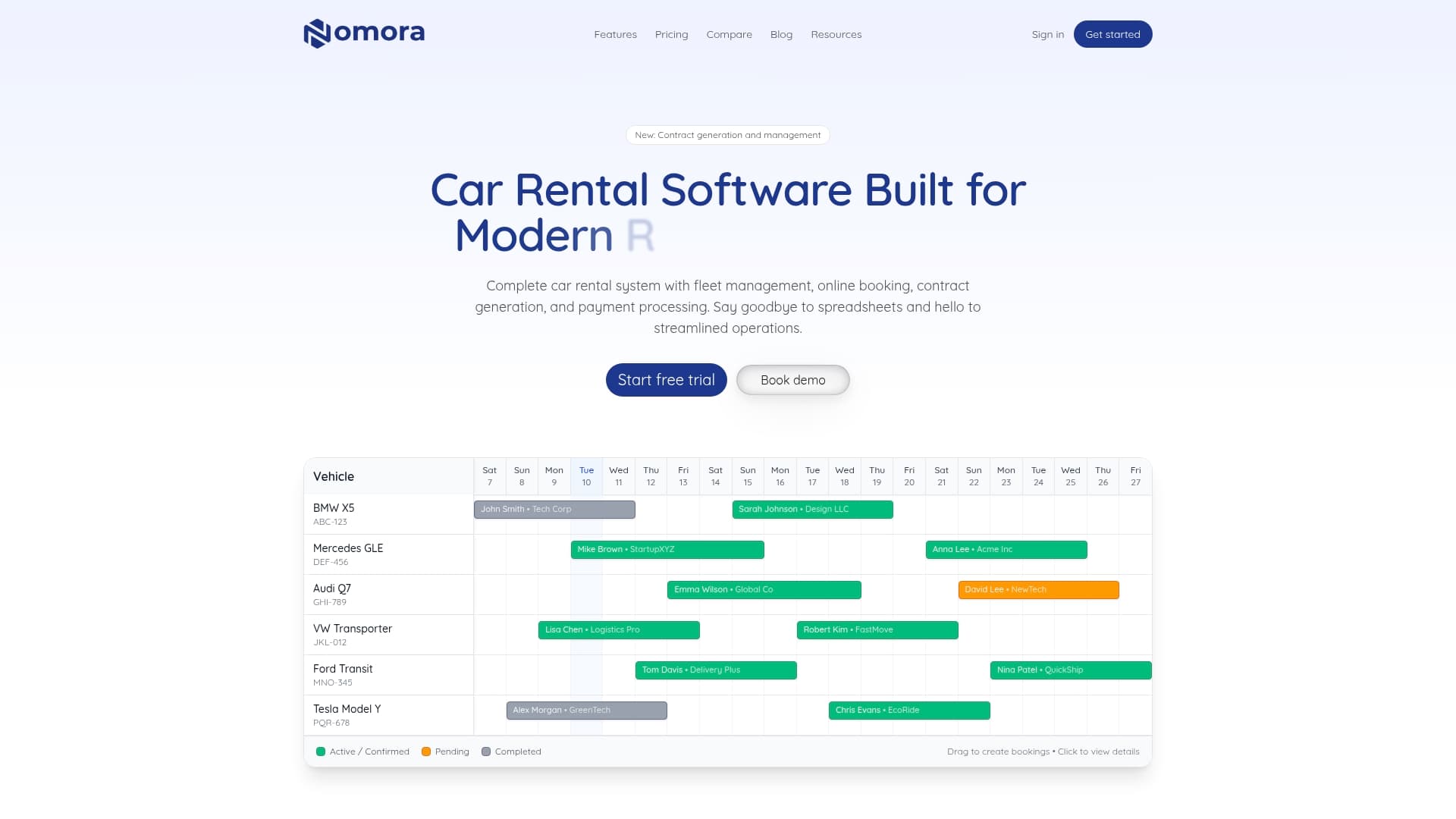
Nomora is a cloud-based car rental management platform built specifically for businesses like yours. You can explore Nomora use cases to see how operators are solving real fleet challenges, learn how the platform helps you prevent double bookings with real-time inventory sync, and discover purpose-built tools for multi-location fleet management. Setup takes 24 to 48 hours, so the gap between where your fleet is today and where it could be is smaller than you think.
Frequently asked questions
What are essential fleet management KPIs for rental businesses?
The key KPIs are utilization rate, maintenance cost as a percentage of revenue, revenue per available car day (RevPACD), and cost per mile driven. Tracking these monthly gives you the clearest picture of fleet health and profitability.
How does predictive maintenance impact rental car fleets?
Predictive maintenance cuts breakdowns and related costs by 18 to 22%, which directly reduces rental downtime and keeps more vehicles available for customers. Fewer emergency repairs also means more predictable operating expenses.
What technology should small rental businesses prioritize first?
Start with telematics and basic AI forecasting before moving to more advanced platforms. This foundation gives you the data visibility needed to make every subsequent technology investment more effective.
How does centralized fleet management help with multi-location rentals?
Centralized cloud software prevents double bookings and keeps fleet availability balanced across all sites, enabling utilization gains of up to 20%. It replaces the guesswork of managing each location in isolation with a single, real-time view of your entire operation.
Recommended